Most Fort Walton Beach homeowners never think about their ductwork — until the energy bills spike, certain rooms stop cooling properly, or an HVAC technician opens the attic and delivers bad news. Ductwork problems are the most underdiagnosed source of HVAC inefficiency in Okaloosa County homes, and the majority of cases trace back to installation errors that should never have passed inspection.
This guide covers every significant poorly installed ductwork signs Fort Walton Beach homeowners should know, how to distinguish cosmetic issues from serious performance problems, and when a repair versus a full redesign makes sense. If you bought a home here in the last 20 years without having the ductwork independently inspected, this article is for you.
Why Fort Walton Beach Homes Are Especially Prone to Duct Problems
Several factors make poorly designed or installed ductwork particularly common in this area:
Rapid New Construction Through the 2000s
The Okaloosa County housing boom from 2000–2008 produced thousands of homes built quickly with subcontracted HVAC crews under significant cost pressure. Ductwork was often rushed, undersized, or improperly sealed in the process.
Humidity and Heat Cause Materials to Degrade Faster
Fort Walton Beach’s climate is brutal on flex duct insulation. UV exposure in attics, temperature swings between 130°F attic heat and 70°F conditioned air, and high ambient humidity cause flex duct to sag, tear, and delaminate faster than in drier climates.
Hurricane Straps and Retrofits Often Disrupt Ductwork
Post-storm retrofitting, room additions, and insulation upgrades — common in Florida homes — frequently disturb existing duct runs without properly resealing joints. This creates hidden leaks that reduce system efficiency by 20–40%.
9 Poorly Installed Ductwork Signs Fort Walton Beach Homeowners Should Know
1. Rooms That Won’t Cool No Matter How Long the AC Runs
If one or two rooms in your home stay stubbornly warm even after the rest of the house cools down, the cause is usually restricted or leaking ductwork serving those rooms. A properly designed system delivers balanced airflow to every room. Persistent hot spots almost always trace to supply duct undersizing, a disconnected duct run, or a collapsed flex duct section.
2. Unusually High Energy Bills for Your Home’s Size
The average Fort Walton Beach home with proper ductwork should cool efficiently even during peak July–August heat. If your electric bills are significantly higher than neighbors with similar-sized homes, leaking ductwork is a prime suspect. Studies by the Department of Energy show that duct leakage alone can account for 20–30% of total HVAC energy waste.
| Benchmark: In Fort Walton Beach, a properly maintained 2,000 sq ft home should average $150–$200/month in summer electric bills. Consistently higher figures warrant a duct inspection. |
3. Excessive Dust on Vents and Surfaces
Supply vents that are visibly dusty shortly after cleaning indicate that your system is pulling in unconditioned, dusty attic air through duct leaks. Return air leaks in attic duct sections are especially problematic — they bypass your filter entirely and push attic insulation particles and mold spores directly into your living space.
4. Musty or Stale Odors When the AC Turns On
A musty smell from your vents is a strong signal that mold has established itself somewhere in the duct system — either at the air handler, in leaking duct sections drawing in humid attic air, or at poorly sealed duct joints where condensation accumulates. This is one of the most dangerous poorly installed ductwork signs Fort Walton Beach residents report because it directly impacts indoor air quality and respiratory health.
5. Visible Duct Damage, Sagging, or Disconnected Sections
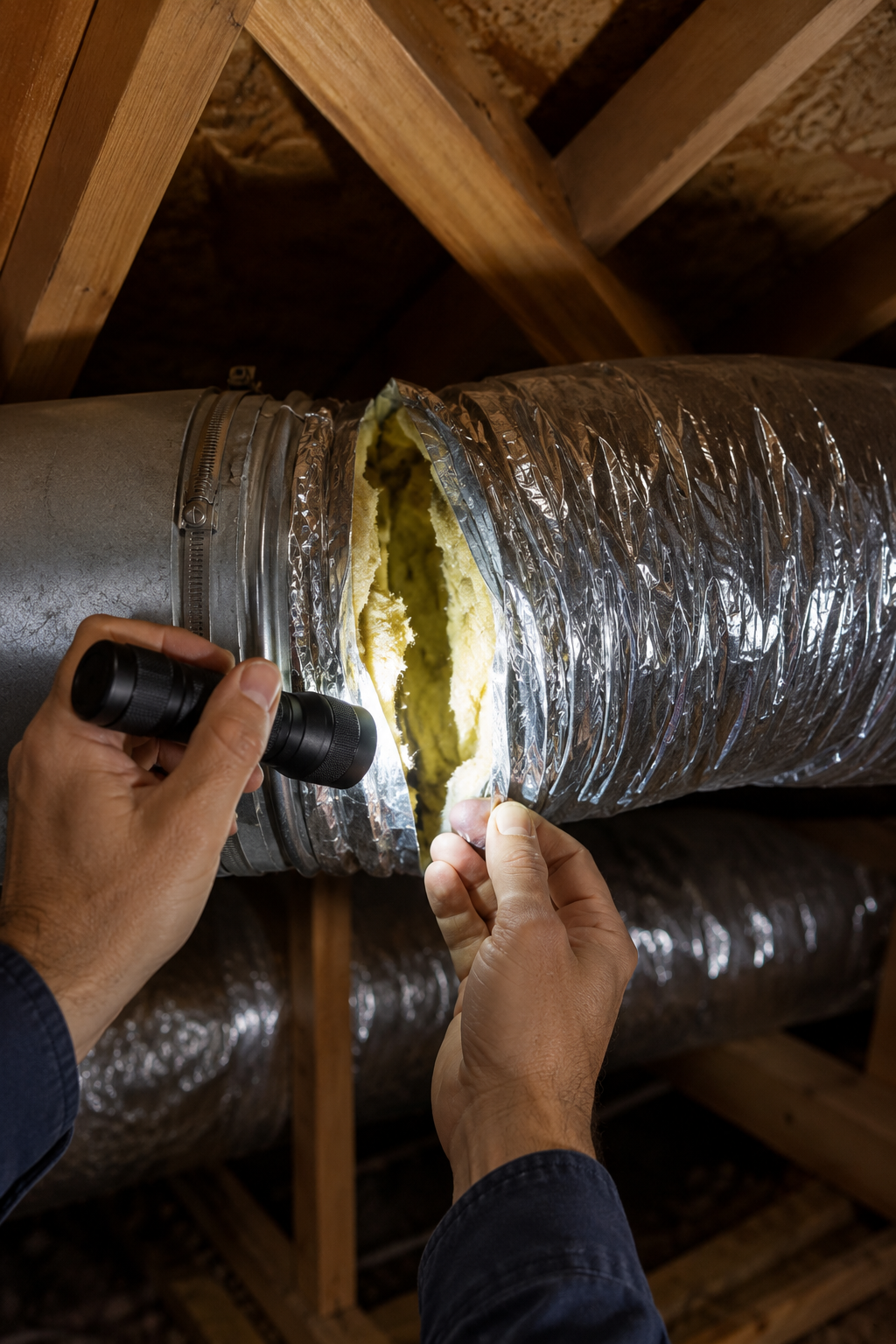
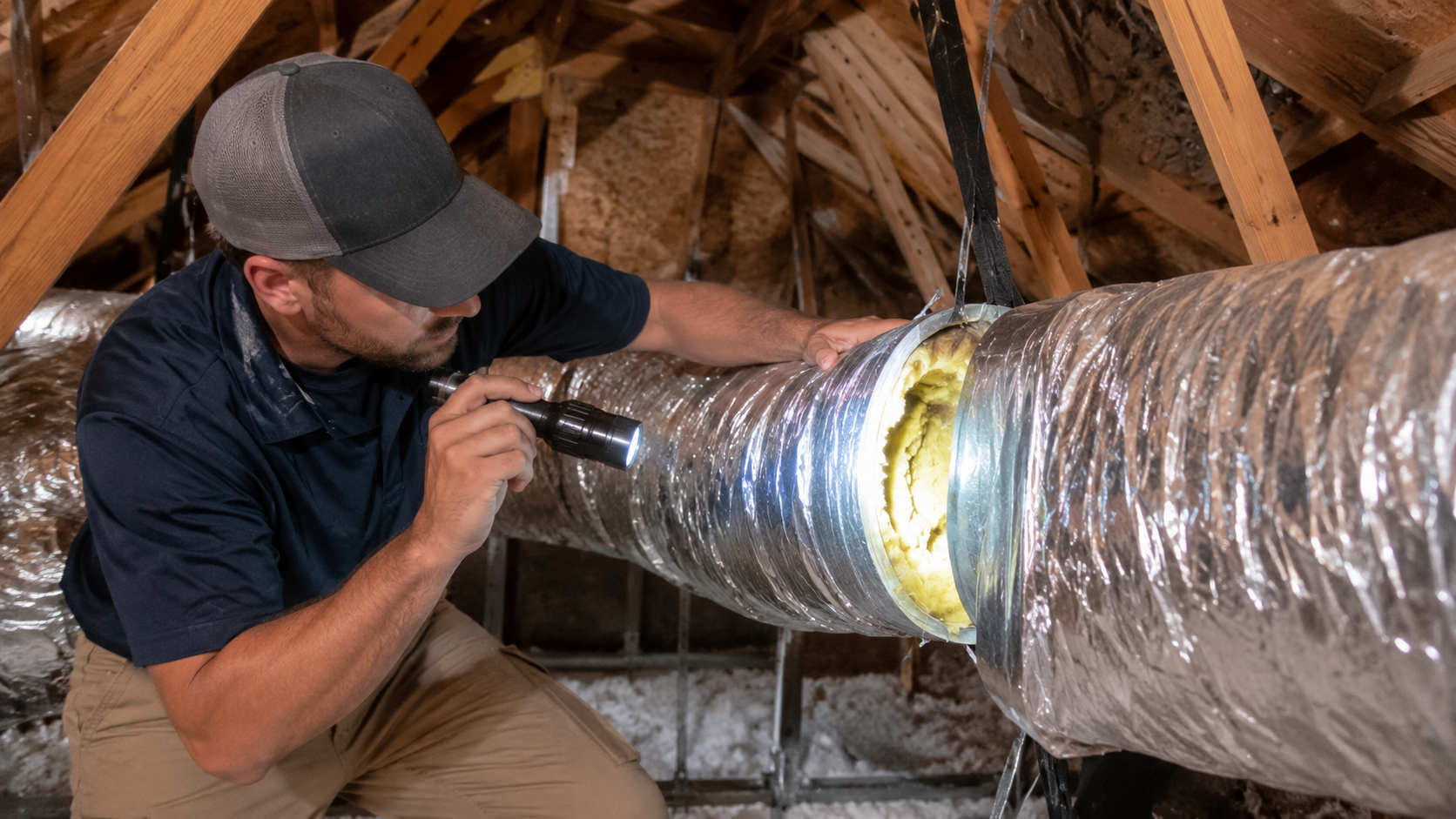
Any homeowner with attic access can do a basic visual check. Signs of poorly installed or failing ductwork include:
- Flex duct hanging loosely or drooping between support points (should be supported every 4–5 feet)
- Disconnected joints where flex duct has pulled away from register boots or plenums
- Duct insulation that is wet, torn, or deteriorated
- Sheet metal ductwork with visible gaps at seams, missing mastic, or sheet metal screws as the only fastener (screws alone are not sufficient — mastic or tape is required for airtight sealing)
6. HVAC System Running Continuously Without Reaching Set Temperature
A properly sized HVAC system in Fort Walton Beach should cycle off once it reaches the set temperature. If your system runs almost nonstop in summer without ever fully satisfying the thermostat, the cause could be duct leakage (conditioned air escaping before reaching rooms), undersized ductwork that restricts airflow, or an improperly balanced system.
7. Noisy Ductwork — Popping, Banging, or Whistling
Some duct noise when the system cycles on or off is normal. Persistent banging (oil-canning from undersized sheet metal duct flexing under pressure), whistling at registers (too much velocity due to undersized duct runs), or rattling (loose connections) are indicators of either poor installation or deterioration over time.
8. Condensation or Water Stains Around Vents
In Fort Walton Beach’s humidity, cold air in supply ducts combined with warm attic air at a duct leak creates condensation. Water stains on ceiling drywall around supply vents, or water pooling near register boots, confirm duct leakage. Left untreated, this causes drywall damage and mold growth.
9. Different Temperatures on the Same Floor
A north-facing bedroom that is 5°F warmer than the living room on the same floor points to airflow imbalance — typically from improperly sized or improperly balanced supply and return duct runs. This is a design failure that a basic duct repair may not fully resolve. Proper HVAC ductwork design using Manual J and Manual D calculations is required for balanced whole-home comfort.
The Difference Between a Duct Repair and a Duct Redesign
Not all duct problems require a full system redesign. Here is how to think about the decision:
When Duct Repair Is the Right Call
Isolated leaks at joints, a disconnected section of flex duct, or deteriorated duct insulation in a contained area — these are repair situations. A professional ductwork repair and remodeling service can seal, reconnect, and re-insulate affected sections, typically restoring 80–90% of lost efficiency.
When You Need a Full Duct Redesign
If your home has persistent whole-house comfort issues, multiple rooms with airflow problems, or ductwork over 20 years old with widespread deterioration, piecemeal repairs become more expensive than a planned redesign. A new custom HVAC ductwork design Fort Walton Beach using proper load calculations eliminates the root cause rather than patching symptoms.
How Florida Heating and Air Conditioning Diagnoses Duct Problems
Florida Heating and Air Conditioning LLC uses several diagnostic tools to accurately assess Fort Walton Beach ductwork — beyond a simple visual inspection:
- Duct Blaster Testing: Pressurizes the duct system to measure total leakage rate — identifies how much conditioned air is being lost and where.
- Thermal Imaging: Infrared cameras reveal temperature differentials at duct joints, leaks, and poorly insulated sections invisible to the naked eye.
- Static Pressure Testing: Measures pressure drop across the system to identify undersized duct runs, blocked returns, and system imbalances.
- Visual Attic Inspection: Full attic walkthrough with documentation of all visible duct conditions — support failures, disconnections, insulation damage.
Our reliable heat and air conditioning ductwork repair Fort Walton Beach service starts with diagnosis — not assumptions. Every recommendation we make comes from measured data, not guesswork.